
Fall Chill and Rodent Invasions: How Temperature Drops Drive Field Mice Indoors
Learn why autumn temperature drops push field mice into residential properties and discover the critical structural exclusion points you need to inspect and seal before winter.
The Autumn Shift: Why Rodents Seek Shelter Indoors
As summer fades and autumn sets in across Northwest Indiana, outdoor ecosystems undergo rapid changes. Deciduous trees shed their foliage, garden beds wither, and nighttime temperatures drop steadily. While homeowners in Munster start turning on their heating systems and preparing for winter, local wildlife undergoes its own seasonal preparations.
For field mice, deer mice, and standard house mice, late September through November is a critical survival window. Mice are warm-blooded mammals with high metabolic rates, requiring consistent food sources and a stable core body temperature to survive. Out in open fields, prairie patches, and residential yards, their natural resources begin to dry up. Tall grasses that offered cover from predators die down, wild seed heads become scarce, and standing water freezes during early overnight frosts.
These environmental pressures prompt a strong biological directive: find secure, warm shelter with an accessible food supply. Residential homes, with their heated basements, insulated crawlspaces, and well-stocked pantries, represent the ideal winter refuge. Understanding the mechanics of this seasonal migration and identifying where mice breach structural barriers is the first step in protecting your property.
The Survival Instincts of Field Mice in Late Autumn
Field mice do not hibernate. Instead, they remain active throughout the coldest months of the year, relying either on food caches established during early fall or on continuous foraging in sheltered environments. When the first sustained cold snaps arrive, mice actively patrol the perimeter of structures, seeking air currents that carry escaping heat and the scent of stored food.
A mouse’s physical capabilities make this search remarkably efficient:
- Incredible Compression: A field mouse can squeeze through an opening no larger than a standard pencil or a dime (roughly one-quarter of an inch in diameter). Their ribs are hinged and can collapse slightly to fit through tight voids.
- Agile Climbers: Mice have specialized claws and strong leg muscles, allowing them to scale rough brick, textured siding, downspouts, and nearby tree branches with ease.
- Keen Senses: While their eyesight is relatively weak, their sense of smell, touch (via whiskers), and hearing are exceptionally sharp. They follow warmth radiating from utility penetrations and gaps around foundations.
- Persistent Gnawing: Rodent incisors grow continuously throughout their lives. If a mouse finds a crack that is slightly too small, it will use its hard enamel to chew away weathered wood, vinyl siding, foam insulation, or worn weatherstripping until the gap accommodates its body.
Key Structural Exclusion Points to Inspect
Effective rodent control relies heavily on physical exclusion—the practice of sealing structural gaps to deny pests entry in the first place. Inspecting a property requires looking at the building through the eyes of a rodent. Begin at ground level and systematically work your way upward around the entire exterior envelope.
1. Foundation Sills and Expansion Joints
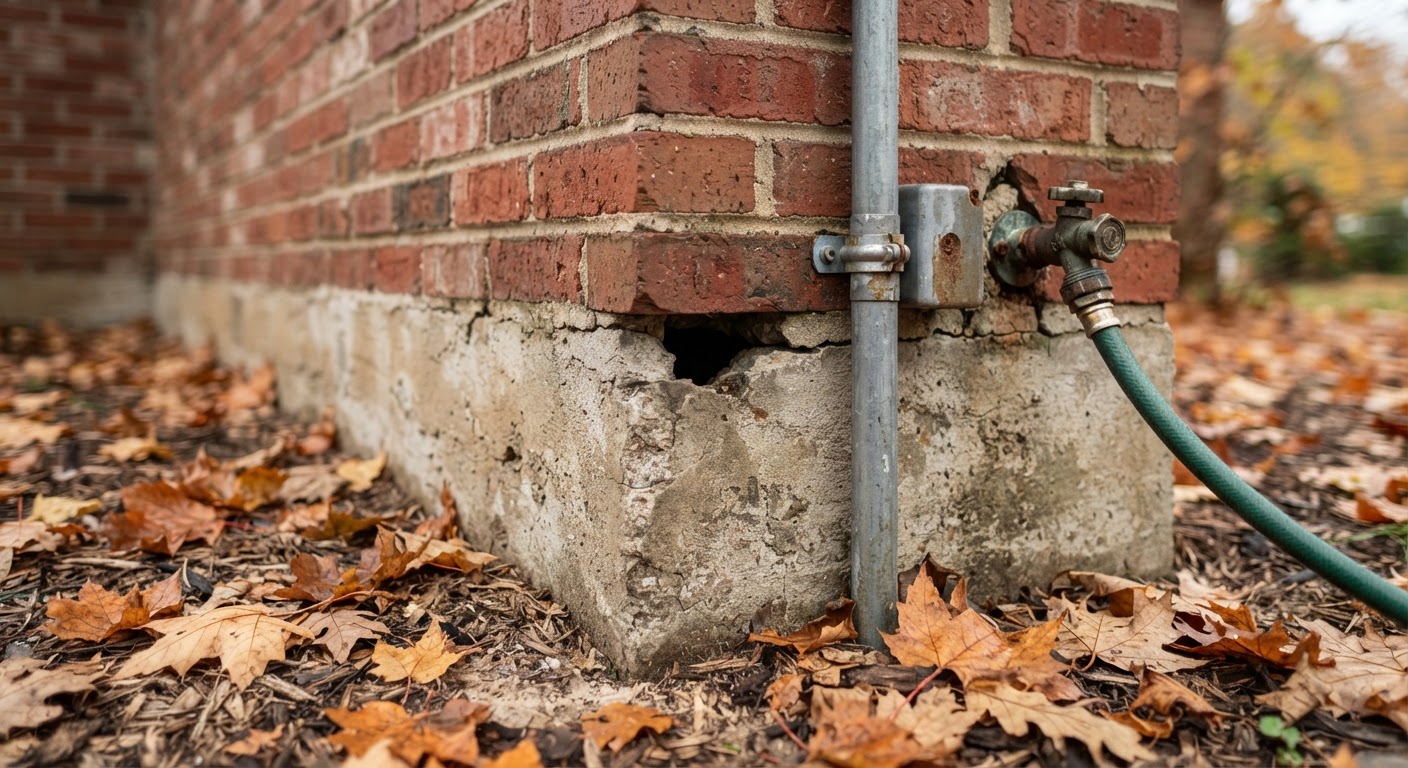
Where the wooden framing of a house rests upon the poured concrete or block foundation (the sill plate), subtle settling over time often creates narrow voids. Even a minor gap between the mudsill and the top of the foundation provides enough clearance for a field mouse to slip inside. Pay special attention to corners, basement window frames, and the transition areas where brick veneer or siding meets the foundation wall.
2. Utility Penetrations and Pipe Chases
Every home requires lines for plumbing, electricity, natural gas, and climate control. Contractors often drill round holes through exterior walls to accommodate conduit, outdoor spigots, air conditioning refrigerant lines, and dryer vents. Frequently, the gap around the pipe or wire is sealed with basic expanding foam or left partially open. Field mice can easily chew through standard polyurethane foam or navigate around loose escutcheon plates to gain direct access to wall cavities.
3. Garage Doors and Track Corners
Attached garages are one of the most common staging grounds for rodent infestations. The rubber weatherstripping along the bottom of a garage door frequently cracks, stiffens, or shrinks in cooler weather. Mice often gnaw away the bottom corners of these rubber seals, slipping into the garage under the cover of darkness. Once inside, they can nest within stored cardboard boxes, vehicle engine bays, or find further entryways leading into the main residence.
4. Dryer and Exhaust Vents
Exterior vents for laundry dryers, bathroom exhaust fans, and kitchen hoods pump warm, scented air directly outside. This warmth acts as a beacon for cold field mice. If the exterior vent hood lacks a functional damper or protective metal screen, rodents will enter the ductwork, sometimes chewing through flexible duct material to enter ceilings or wall spaces.
5. Crawlspace Vents and Access Hatches
Homes built over crawlspaces face unique vulnerabilities during the fall. Crawlspace ventilation grates can corrode, warp, or pull away from the masonry. If access wells or exterior crawlspace doors do not fit tightly against their frames, mice will drop into the protected, insulated area beneath your floors, tearing away fiberglass batts to build soft nests.
6. Rooflines, Fascia, and Soffits
Mice do not stay confined to ground level. Overhanging tree limbs, utility lines, and trellis systems provide direct pathways to your roof. Inspect roof intersections, dormers, and the edges of soffits. Gaps beneath warped fascia boards or missing ridge vent caps offer mice an entry point straight into your attic space, where undisturbed blown-in insulation provides optimal nesting conditions.
Selecting the Right Exclusion Materials
One of the most frequent mistakes in seasonal rodent prevention is using improper materials to close gaps. Mice can readily chew through rubber, wood, plastic, standard caulk, and expanding foam. Long-lasting exclusion requires materials that withstand rodent teeth.
- Coarse Steel Wool or Copper Mesh: For small gaps around pipes and foundation cracks, pack the void tightly with woven copper mesh or stainless steel wool. Rodents cannot chew through these metallic fibers without injuring their mouths.
- Elastomeric Caulk and Hydraulic Cement: Seal over copper mesh with high-grade polyurethane sealant, silicone caulk, or exterior masonry patching compound to keep the mesh firmly in place and prevent draft leakage.
- Heavy-Gauge Hardware Cloth: For larger openings such as crawlspace vents, attic louvers, or sump discharge areas, install rust-resistant, galvanized hardware cloth with a mesh size of one-quarter inch or smaller.
- Metal Flashing and Reinforced Door Sweeps: Use aluminum or galvanized steel flashing to cap vulnerable corners on doors, and install commercial-grade, metal-backed door sweeps along the bottom of all exterior and garage doors.
Recognizing Early Signs of an Indoor Rodent Presence
Because field mice are primarily nocturnal and naturally cautious, an initial intrusion often goes unseen. Recognizing early indicators allows you to address the problem before a single pair establishes a breeding colony:
- Droppings: Small, dark pellets measuring roughly one-eighth to one-quarter of an inch with pointed ends, commonly found along baseboards, beneath sinks, and near pantry shelves.
- Scratching Sounds: Faint scuttling, rustling, or squeaking noises inside walls or overhead ceilings, especially late at night when the house is quiet.
- Nesting Evidence: Shredded paper, cardboard, fiberglass insulation, or dried plant debris gathered in dark, undisturbed areas like crawlspaces or behind appliances.
- Gnaw Marks: Fresh chew marks on baseboards, plastic storage containers, or food packaging.
Securing Your Home Against Seasonal Rodent Pressures
Autumn temperature drops are an inevitable part of the seasonal cycle, but a rodent invasion does not have to be. By combining thorough exterior inspections, durable exclusion techniques, and prompt attention to structural vulnerabilities, you can maintain a secure, comfortable living space throughout the colder months.
If you suspect field mice have already breached your perimeter or you need assistance identifying hidden entry points around your foundation and roofline, professional intervention ensures nothing is overlooked. Brevix Pest Management provides detailed inspections and targeted rodent control services in Munster to protect your home before winter arrives.
Need help from Brevix Pest Management?
Contact our team to discuss your service needs in Munster and surrounding service areas.